Some of the best businesses start as a question people keep asking you. For one camping creator with more than half a million followers, that question was simple and relentless: which campsites do you actually recommend?
He had the audience and the editorial instinct. What he didn't have was proof that a real business could stand on top of it. That's exactly what an MVP is for, so that's what we built.
The idea, and the two things it had to prove
The idea was a curated campsite discovery platform. Not another directory stuffed with every site that pays to appear, but a shortlist where every campsite has been personally visited and approved. If it doesn't meet the standard, it doesn't appear. That editorial judgement was the whole product.
But an audience wanting recommendations isn't the same as a business. Two things were genuinely unproven, and the second mattered more than the first.
An audience wanting recommendations isn't the same as a business.
One: will campers actually use it?
The first unknown was demand. People happily ask for tips in the comments. Would they move to a dedicated platform to search, browse and request a booking? Plenty of ideas feel obvious right up until you ask someone to change a habit.
Two: will campsites get on board?
The second unknown was the one that actually decided it. Campsites are the side that'd generate the income, through listings and, later, bookings. If operators wouldn't put their site forward, there was no business, however many campers turned up. So the MVP had to test supply, not just demand.
He'd already felt the limits of doing it himself. An earlier attempt on Wix couldn't do what the idea needed, which is a common place to land: the concept is sound, but the off-the-shelf builder can't quite carry it.
What we actually built
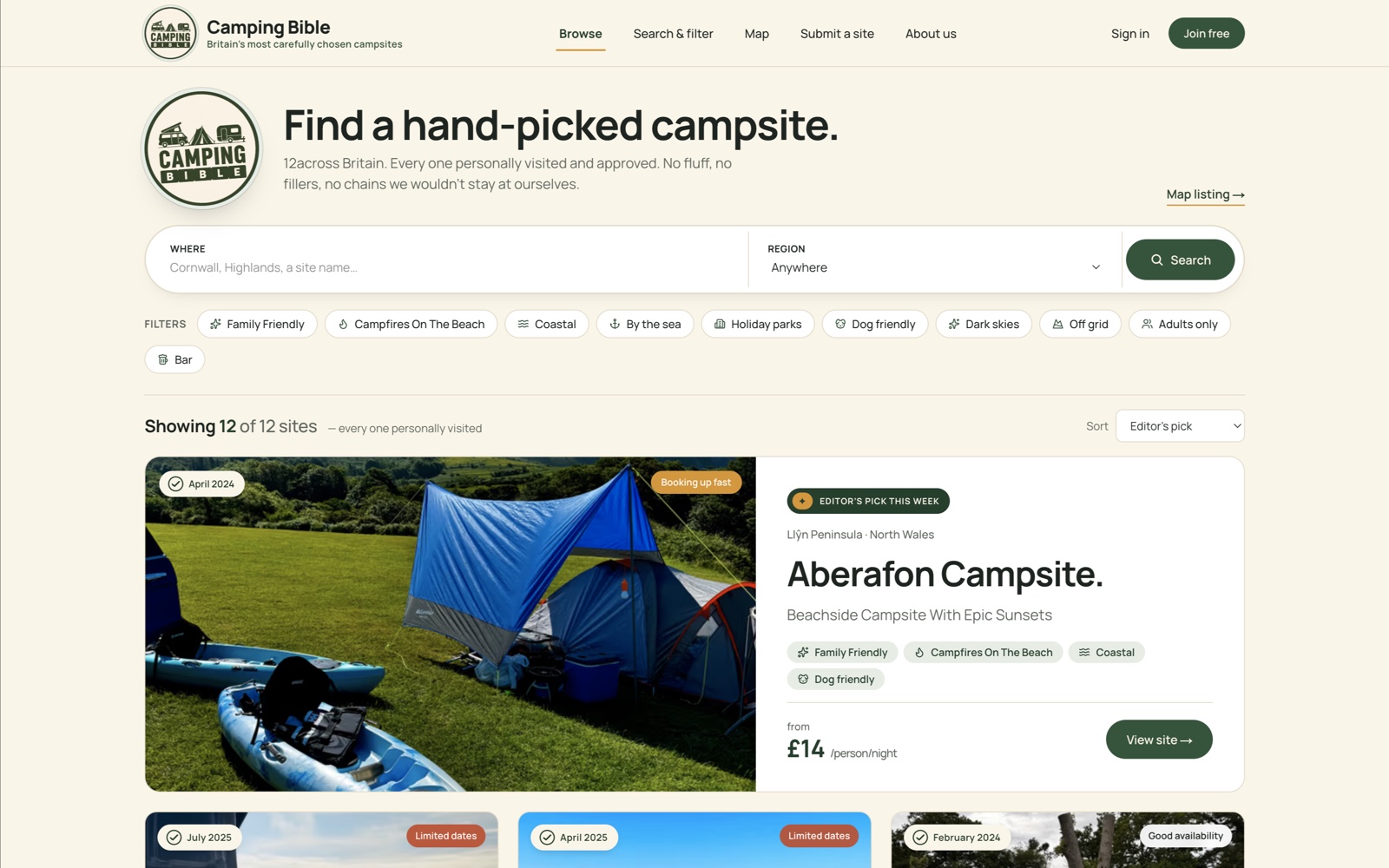
We built the smallest real version that could answer both questions honestly. A discovery experience with a map and filters, a proper listing page for each approved site with a clear 'personally visited and approved' stamp, and a provisional booking request that emails the campsite directly so they can confirm with the guest. Simple accounts so campers can track their requests. An internal tool for him to add and manage listings. And a visible way for operators to submit their own site for consideration.
Listings were free at the start, on purpose. Charging too early would have muddied the test. We wanted the cleanest possible read on one question: will good campsites say yes?
Small now, but built to grow
An MVP should be small, but not short-sighted. We built it on the same stack we use for everything, Next.js and Directus, hosted on Netlify, with the client owning the code outright. Nothing proprietary, nothing locked in.
The money comes later, and only if the test passes: subscriptions for operators, a per-booking fee, a self-serve operator portal, even live availability through a booking system's API. All of that's deliberately out of the MVP, but the foundation was laid so none of it means starting over.
Why this is the right way to test an idea
The alternative is to spend months and a lot of money building the whole platform, launch it, and only then find out whether campsites will play. An MVP flips that. It puts the real thing in front of real people and lets the take-up answer the question first, while the spend is still small and the idea can still change.
That's the point. You're not guessing whether it'll work. You're finding out, cheaply, before the big commitment. From a page people asked questions on, to a product they can actually use and campsites can actually join.
Got an idea people keep asking you for?
If you've got a public-facing idea and you're not yet sure the market will show up, that's the moment for an MVP, not a full build. Tell us the idea and we'll help you find the smallest version worth testing. And if we think it isn't worth building, we'll tell you that too.